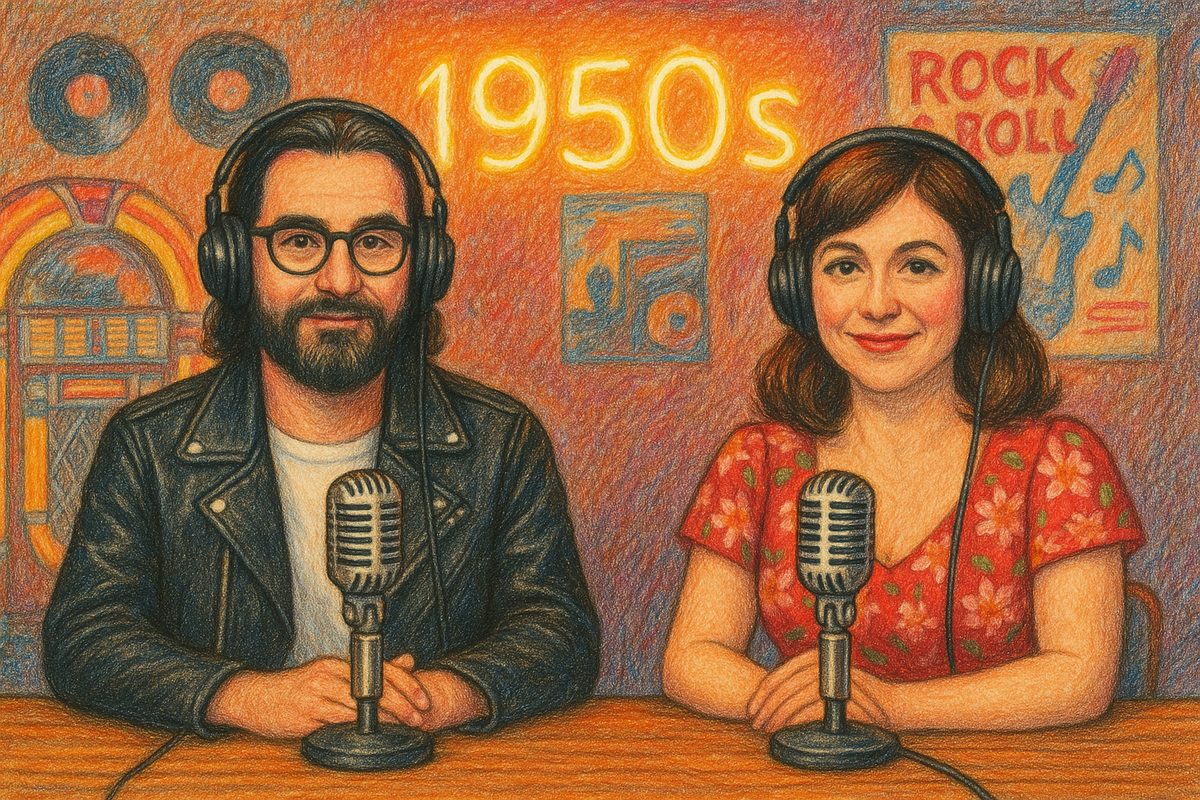
Episode at a Glance
Welcome to the very first chapter of our music journey — the 1950s, a decade of chrome diners, neon lights, jukebox dreams, and the spark that ignited rock & roll. This was the era where crooners and doo-wop harmonies met blues, country, and gospel, fusing into a sound that shook the world. For the first time, youth culture found its own identity — louder, faster, freer.
👥 Meet Your Hosts
Daniel – Grew up on rock and metal, fascinated by hidden stories, rare B-sides, and behind-the-scenes studio lore.
Annabelle – Lives between pop energy, Latin grooves, and soul. For her, music is pure emotion, community, and discovery.
🌍 The 1950s Zeitgeist
- 🎸 Teenage revolution: Youth became a cultural force, shaping fashion, slang, and music.
- 📻 Media explosion: Radio DJs, jukeboxes, TV, and movies turned local hits into worldwide phenomena.
- 💿 Technology leaps: Vinyl 45s, magnetic tape, and affordable transistor radios reshaped how music was made and heard.
- ⚡ Cultural tensions: Cold War fears, segregation, and conservative family values clashed with new freedoms — while music crossed boundaries.
🎶 The Sound of the 1950s
- Crooners & ballads – Sinatra, Nat King Cole, Doris Day defined elegance and romance.
- Doo-wop – Street-corner harmonies, teenage dreams, and the roots of vocal group culture.
- Rockabilly – Country meets R&B: Carl Perkins, Johnny Cash, Wanda Jackson.
- Electric blues – Muddy Waters, Howlin’ Wolf, B.B. King amplified the guitar.
- Gospel & soul roots – Ray Charles and Sam Cooke shaped a new vocal intensity.
- Jazz innovations – Miles Davis (Kind of Blue), Dave Brubeck (Take Five) added sophistication under the rock revolution.
🌟 Pioneers & Icons
- Elvis Presley – Rockabilly charisma & the first true rock superstar.
- Chuck Berry – Story-songs, iconic riffs, blueprint for generations.
- Little Richard – Explosive vocals & flamboyant stage presence.
- Buddy Holly & The Crickets – Glasses, sincerity, and the band model.
- Fats Domino – Soulful New Orleans piano grooves.
- Bo Diddley – The primal “Bo Diddley beat” still echoes today.
- Jerry Lee Lewis – Wild piano fire & pure chaos.
- The Everly Brothers – Harmonies that inspired The Beatles and Simon & Garfunkel.
- Wanda Jackson – The Queen of Rockabilly, showing women could rock just as hard.
🎧 Suggested Listening Playlist
- Elvis Presley — That’s All Right (1954)
- Chuck Berry — Johnny B. Goode (1958)
- Little Richard — Tutti Frutti (1955)
- Buddy Holly — Peggy Sue (1957)
- Fats Domino — Blueberry Hill (1956)
- Bo Diddley — Bo Diddley (1955)
- Jerry Lee Lewis — Great Balls of Fire (1957)
- The Everly Brothers — Wake Up Little Susie (1957)
- Bill Haley & His Comets — Rock Around the Clock (1954)
- Ray Charles — I Got a Woman (1954)
- Nat King Cole — Unforgettable (1951)
- Doris Day — Que Sera, Sera (1956)
- Miles Davis — Kind of Blue (1959)
- Édith Piaf — La Vie en Rose (1950s recordings)
- João Gilberto — Chega de Saudade (1959)
💡 Core Ideas in This Episode
- Form meets feel: Simple chords turned into powerful performances.
- Studio magic: Tape, echo chambers, and singles shaped the modern pop sound.
- Culture shift: Music became identity, rebellion, and a bridge across race and class.
- Global roots: From French chanson to Brazilian bossa nova — music was already international.
✨ Takeaway
The 1950s weren’t just about a new musical style — they proved that music could be a melting pot of cultures. Rock & roll transformed energy, identity, and innovation into a global language, setting the stage for every revolution that followed.
📌 Don’t forget to subscribe for the full journey through every decade of music history — from the 1950s all the way to today. Hit the bell 🔔 so you never miss an episode!